for the independent expert
Right now, your expertise is not an asset. It's a bottleneck with your name on it
You built a method good enough that everything routes through you. That's the problem.
There is a way to give people your answer without giving them your calendar. Even the answer "no". And nothing hollow ever wears your name.
01 / the ceiling you built
You did not built a business.
You built a job with a ceiling you constructed yourself.
Your method works. That is not in question. Clients pay for it, refer it, depend on it. But the method lives in one place, in your head, and so the business is your calendar.
Every real decision waits for you. Every engagement needs you in the room.
The quarter you were half out of commission, you watched the whole thing slow to your speed.
You are the most valuable person in your business and the hardest constraint on it, at the same time. You are the ceiling, and you are the one who built it.
Clients pay for you, in the room. So the business can never grow past your calendar
02 / the obvious fix made it worse.
You already tried the obvious fix: an AI fed with your own content. It handed you a hollow version of yourself.
So you tried the thing everyone is trying. You fed it everything you had published and asked it to be you...
you may recognize this session
two days later...
It promised to remember. Wednesday morning, you find out what that promise was worth.
an illustrative session with a custom gpt.
It had your words. It doesn't have your judgment.
Even a tool with memory can store your rule as words. What it cannot hold is the judgment behind the rule: when it applies, and when you yourself would make an exception.
You shut it off, and you were right to. Putting it in front of a client would have cost you the one thing you cannot refund: their trust in your judgment.
Which left you with two options, and you hated both. Stay the person everything waits for. Or hand your work to an AI that flattens it into something generic.
Stay the bottleneck, or hand your life's work to a machine that flattens you.
03 / the old way and the new way
There is a third option. It comes down to one difference.
Start with the fear itself.
Being flattened. Being misquoted in your own name. Being made replaceable by a hollow copy.
Every one of those is something a clone does. And what we build is not a clone.
You were never afraid of AI. You were afraid of clones, and you were right to be.
Here is the difference: an AI can copy what you say, or it can learn how you decide. Everything you have tried copies your words.
This option studies your decisions the way an apprentice studies a master, until it can reason the way you would.
You are not copied. You are studied, and you stay the master.

Public AI
cheap / generic / exposed
Your Blue Island AI
your firm's judgment, excavated and owned, on a frontier model you don't build
Build your own
private / months of dev / elite budget
Why the middle? Look at what the corporations did.
They wanted an AI that is private and their own, so they built their own systems, and paid for it with dedicated teams, a year of work, and millions. The right idea, at a price no independent expert would ever sign.
The middle road gets you the same two things, without building anything.
Your judgment, excavated and owned, running on an engine that already exists, under your control. Private, and yours. And the day a better engine arrives, you swap engines. The asset does not move.
The old way: The Output Mirror.
It reflects your finished work, the talks, the memos, the things you already produced. A mirror can only return the surface, so it forgets, invents, and flattens.
What it could never hold.
The most valuable part of your expertise, how you actually decide, including the calls you would never make, was never in the work to begin with. You never published your refusals.
The New Way: the Judgment Excavation Method.
A human digs out how you decide, on your own real decisions, refusals included. That is why the last attempt failed. Not because your judgment cannot be encoded. Because no one had ever excavated it.
An AI chatbot only reflects what you put in. We excavate how you decide.
04 / the judgment excavation method
Four moves. Done by a human, on your own real decisions.
This is the part no signup tool can do, no matter how good the AI gets.
A signup starts from what you upload. This starts from how you actually think, and it takes a person to dig that out.
01
The Dig
how you actually decide, case by case. the rules you apply without naming them. the eighty to ninety percent never written down.
02
The Refusal Map
what your method forbids. the call you would never make. the line you do not cross. it never appeared in your work because you never produced it.
03
The Apprenticeship
your decision-making encoded into a system that reasons the way you would, defers on the genuinely novel, and never invents in your name.
04
The Owned Vault
it lives on your own machine. you own it outright. it does not die if you stop paying, and it compounds with every case you add.
Notice what the Refusal Map does to your oldest objection. You assumed any system would give generic advice you would never give.
The opposite is true here: because it knows what you refuse, it declines what your method would not sanction. The thing you feared most becomes the thing it is best at.
When a question goes past what your method covers, it does not halucinate. It defers to you.
05 / what you are probably thinking
Three objections, and why each one is already answered.
"It will just be a generic strategy bot."
The Refusal Map is the answer to this. Because it knows the advice your method forbids, it declines what your method would not sanction. A generic bot has no refusals. Yours is built from them.
"You cannot capture years of judgment."
The bottleneck was never whether your judgment can be encoded. It was that no one ever excavated it. And we prove it on one real case first, before you commit to anything larger, on your own material.
"This is just another subscription I will be renting forever."
The Owned Vault is the opposite of rented access. The vault lives on your own machine and you own it outright. It is not a hosted subscription that ends when you stop paying; the asset is yours to keep, and it compounds with every case you add.
the low-risk first step
Find out whether your judgment holds up outside your own head.
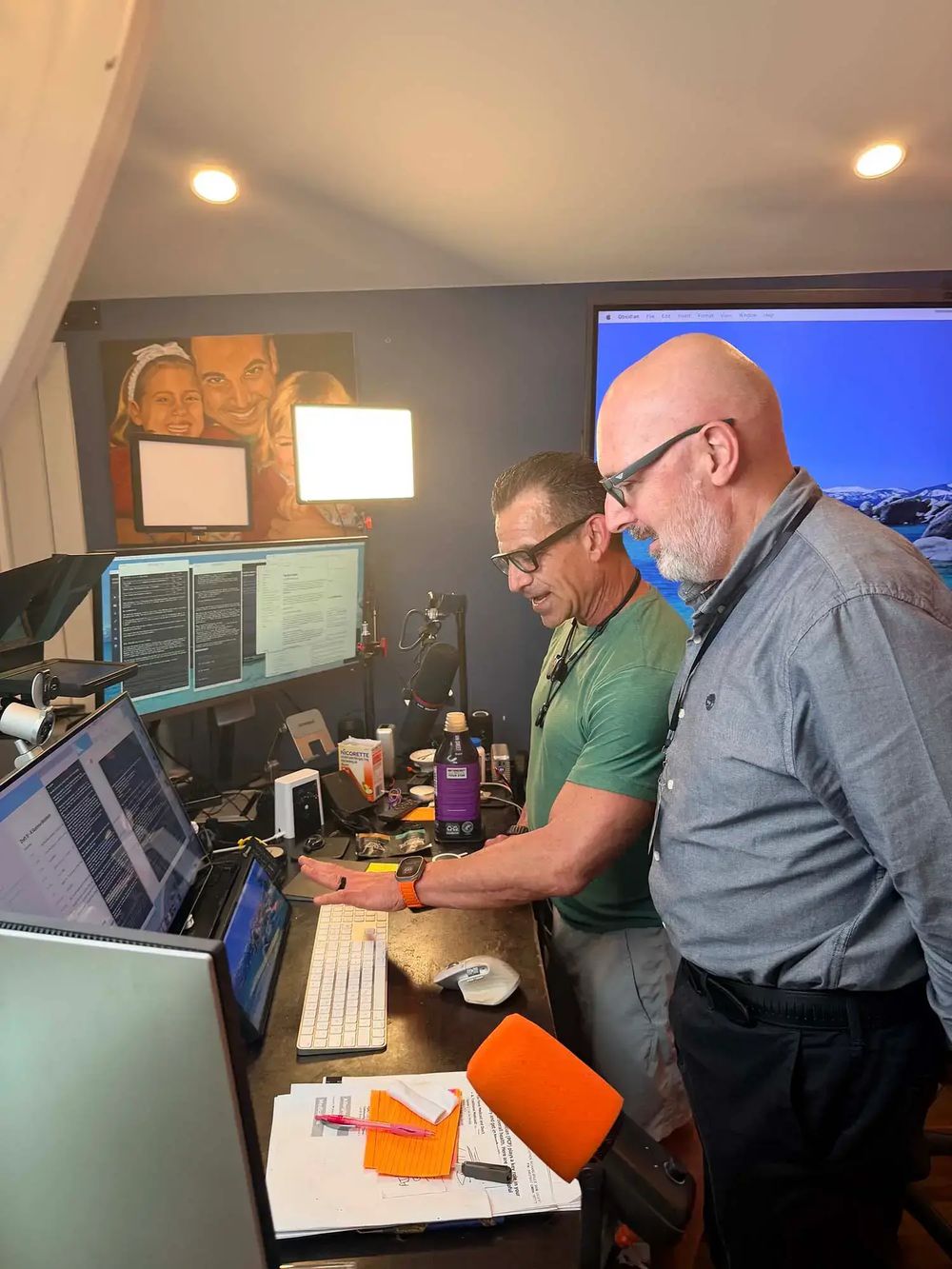
koen de wit and rich schefren

with russell brunson · certified funnel builder award
06 / who is behind this
A method this personal is not run by a platform. It is run by a person.
This is not a product with a signup. It is bespoke work done by a person on your real material, so it is fair to ask who.
Your Blue Island AI is the work of Koen De Wit. For close to a decade, under his practice The Funnel Therapist, he has helped coaches, consultants, speakers, and creators with their marketing and their funnels.
The reason a person sits here and not a signup form is the whole argument of this page. The Dig and The Refusal Map cannot be performed by software. Excavating how you decide is the un-commoditizable work no signup can do on your behalf.
He is mentored by Rich Schefren, the strategist the biggest names in marketing quietly turn to. People like Jay Abraham, Ryan Deiss, Todd Brown and Russell Brunson.
The principle this method draws from is Rich's: the most valuable part of an expert's thinking is the part that never makes it onto the page. That is exactly what this method exists to recover.
a few of the people koen has worked with
Creators with YouTube audiences approaching a million and beyond: Dr. Orion Taraban (PsycHacks), Brian Scott (The Reality Revolution), and Olympic medalist Tony Jeffries (Boxing Fitness Academy).
Coaches and authors with real bodies of work: Jessica Cunningham (Belief Coding) and Cicely Simpson, award-winning author of "Pull Up Your Chair."
Two Comma Club winners and seven-figure experts: Jeremy Miner (7th Level), Natasha Takahashi, Bruce Guan, and Ben Robinson.
And the rooms behind them: consultants who are approved providers to Meta, Google, and Amazon. He also consulted for ClickFunnels in their funnel-builder coaching and certification program.
The size of the following was never the point. What these people share is expertise worth excavating, and that is the only thing that matters here, whether you are known to millions or to the few hundred clients who pay you precisely because of how you think.
The judgment in every one of these engagements belonged to the expert. The work was to recover it and hand it back. That is the work here.
07 / what you get
What you end up owning, and how you start.
Not a subscription. Not a login. A system that is yours. Here is what you walk away with.
- A system that reasons the way you decide, on your own machine, owned outright.
- A guardrail that declines what your method forbids, instead of inventing in your name.
- Your judgment, finally documented: the way you decide and the calls you refuse, written down for the first time and yours to keep.
- Agents you can spin off it as you need them, each carrying the same judgment.
- An asset that compounds with every case you add, and does not die if you stop paying.
what a vault looks like
- 01-identity/
- voice-and-tone.md
- core-philosophy.md
- do-not-say.md
- 02-positioning/
- ip-ownership-and-sovereignty.md
- usp-and-mechanism.md
- 03-avatars/
- 04-frameworks-and-IP/
- distinctions.md
- kb-first-method.md
- 05-proof/
- 06-content-bank/
- pillars.md
- 07-source-material/
You do not commit to the whole thing to find out if it works.
You start with one real decision of yours, watch your judgment reproduced, including a refusal your method would make, and only go further once you have seen it hold up. The full build follows; the ongoing deepening is yours to take or leave.
the guarantee that fits this
You hold the verdict.
Before the full build proceeds, you certify, on your own real cases, that it reproduces your judgment. If it does not pass, it does not proceed. You are the authority on whether it is really you, because you are the only one who could be. A money-back line would be beside the point; the only verdict that counts is yours, on your own material.
what this costs
No package menu, because your busniness is not a tier. The build is bespoke, priced from what your method actually needs, which is a conversation, not a checkout.
What is fixed is where you start: one real decision, a defined, low-risk first step where the only thing you decide is whether to keep going, after you have already seen it work.
08 / why now, and not in a year
The window is not about being early to a trend.
Your peers are already doing this. Some of the names you quietly measure yourself against have an AI of themselves out in the world, and the ones who moved first are being rewarded for it.
The window is about moving while the field is still building clones it will regret, and building yours correctly: an apprentice you own, that reasons the way you decide, that you stay the head of.
The expert who waits does not get a better version later. He gets a head start handed to whoever moved first.
09 / questions
The questions you are already asking.
Those are built from what you produced, your words and your output. They reflect the surface and miss the reasoning underneath, so they forget, invent, and flatten.
This is built from how you decide, including what you refuse, dug out by a person from your real decisions. A signup can't reach that. It's why this doesn't come back hollow.
Four moves: we dig out how you decide, case by case; we map what you refuse; we encode it into the system; you own the result on your machine.
You start with one real decision, so you watch it work on your own material before committing to the full build.
Your job is to think out loud. The building is ours.
You don't take it on faith. The first step reproduces your judgment on one of your own real decisions, in front of you, including a refusal you would make. You certify it's you before the full build goes ahead. If it doesn't pass, it doesn't proceed. You hold the verdict.
Under your control, on your own infrastructure, never a vendor's server. For a regulated firm that is the point: owning it clears the confidentiality bar that rules hosted tools out before price even comes up.
You own it outright. It doesn't vanish if you stop paying, and there's nothing to claw back from a vendor because it was yours from day one. It compounds every time you add a case.
You start with one bounded engagement on a single decision, not a months-long project before you see anything work.
The full build scales with how much of your domain you want encoded, and we scope that up front. Your time is mostly the excavation sessions, thinking through real decisions. The rest is ours.
There's no package menu, because your practice isn't a tier. The build is priced from what it actually needs, which is a conversation, not a checkout. What's fixed is where you start: the Excavation, a defined, paid first step, and that fee credits toward the build.
No. You bring the judgment; we handle the build and the setup on your infrastructure. You use it like any tool that answers questions, except the answers are yours.
A custom AI system, built from how you decide, that lives on your own machine. Ask it something in your field and it reasons to your answer the way you would, declining what it can't answer instead of guessing.
You can spin agents off it, an email writer, a research assistant, each carrying your judgment. You don't log into it. You own it.
That half is the whole point. The bottleneck was never that your judgment can't be encoded.
It's that no one ever excavated it. We don't ask you to write it down. We work through your real decisions and surface the rules you apply without naming them, the way an apprentice learns under a master, not from a manual.
The opposite. Keeping your judgment locked in one head is what caps it, and retires it with you.
The experts whose names became methods didn't hoard theirs; they built something that ran without them and stayed at the head of it. You don't become replaceable.
You become the source it all traces back to, and the authority over everything it produces.
Fair question. For close to a decade I've fixed marketing and funnels for coaches, consultants, and creators as The Funnel Therapist, and Russell Brunson named me a top funnel builder in 2024, 2025 and 2026.
I'm mentored by Rich Schefren, the business strategist that names like Ryan Deiss, Jay Abraham, and Frank Kern go to for advice. But the real answer is simpler: I built this on myself first. The demo above is my own judgment, running. I won't sell you something I haven't already done to my own work.
10 / begin
You built the ceiling. Now build the institution that outlives it.
Encoding your judgment does not make you replaceable. Hoarding it does.
The expert who keeps everything in his own head has not protected his value. He has trapped it, capped it at the size of his calendar, and guaranteed it retires when he does.
The ones whose names became methods did not clone themselves. They built schools of thought that ran in rooms they were not in, and they stayed at the head. You become the source the institution is built on, not the operator who outsourced his brain to a platform.
It starts with a short call, no pitch, just your work and whether this is worth building. If it is a fit, you begin with one real decision and watch your own judgment reproduced. If it cannot hold up, you have lost almost nothing. If it can, you have seen the only proof that counts.
building what no one can copy
© 2027 your blue island ai · all rights reserved
custom ai systems · [email protected]